Ah Naples - a city forever linked with pizza, slicked up sunglass-clad Italian stallions, a sordid mafia undercurrent, and perilous driving... nevermind the near 3000 year greco-roman history. But back to the pizza...
My sister and I arrived fairly late in the evening to Naples to begin our exploration of the Campania region - a tour heavily influenced by food, happily taking 100-mile detours just to seek out the best gelato in one town or an incredible smoked ricotta which was a speciality of another. As we planned to promptly leave Naples the very next day in search of all this wonderful food, it was our top priority to seek out a proper Napoli pizza that evening. We headed to Pizzeria Brandi, which claims to be the inventor of the original Pizza Margherita. We shared some mozarella di bufalo which was creamier and saltier (and far tastier) than any I'd tasted before (though I guess this should be expected since Campania is home of mozarella di bufalo, along with many other amazing cheeses!). The pizzas had a lovely crisp crust and fresh ingredients. What I noticed most was that it was much lighter than pizzas I'd had elsewhere in Europe and the US - you come away feeling nicely full without that heaviness that comes with more processed doughs and greasier toppings.
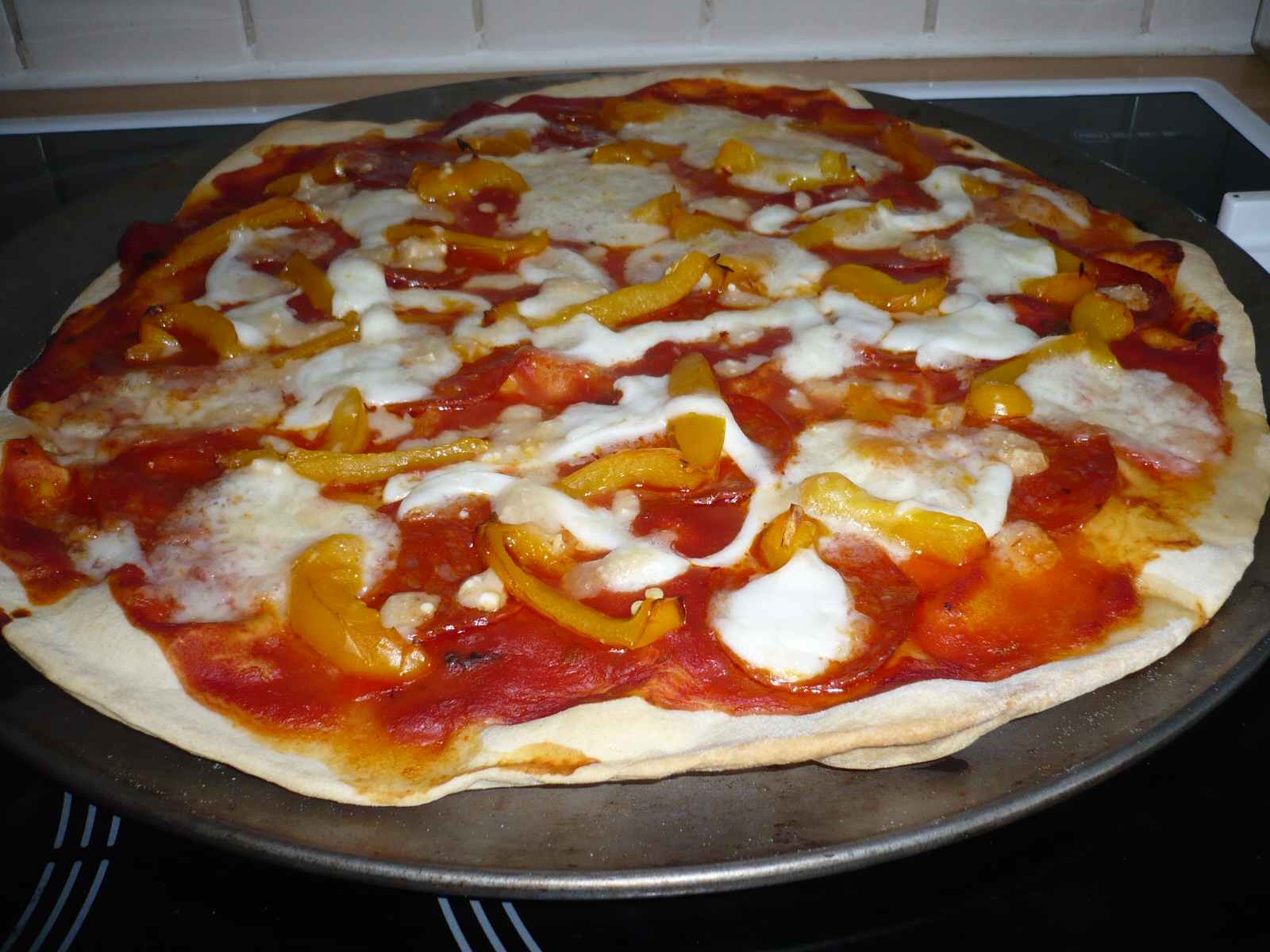
And thus began my love affair with homemade pizza - aiming to bring a little bit of Naples to my very own kitchen table. Homemade pizza night happens roughly once a month now - and while the toppings continue to vary, I never mess with the dough recipe which consistently gives a crispy, airy and delicious base. As much as toppings influence the flavour and tasty-goodness of a pizza, the crust is really what gives it that homemade taste...
The recipe comes from Silvana Franco's recipe book aptly called, Pizza.
And here is the recipe I've used, probably over one hundred times...
(The recipe in the book recommends regular unbleached all-purpose flour, but I've since switched to Tipo 00 - an Italian flour especially for pasta or pizza dough - it makes kneading a lot easier!)
Basic Pizza Dough
1 and 2/3 cups (225 grams) Tipo 00 Flour (or all purpose, if Tipo 00 is not available) plus a little extra for kneading
1/2 teaspoon salt
1 pack dry yeast (1 and 3/4 teaspoon)
2 tablespoons olive oil
1/2 cup (140 ml) tepid water
Put the flour, salt and yeast in a large bowl and mix. Make a well in the center. Add the oil and water to the well and gradually work in the flour to make a soft dough. Sprinkle with a little flour if the mixture feels too sticky, but make sure it is not too dry: the dough should be pliable and smooth.
Transfer the dough onto a lightly floured work surface. Knead for 10 minutes (make sure you stick to the 10 minutes - it will make a difference if you knead it for less time), sprinkling with flour when needed, until dough is smooth and elastic.
Rub some oil over the surface of the dough and return the dough to the bowl. Cover with a clean cloth and leave for about 1 hour until dough has doubled in size (again, best not to skimp on time - and hour or more is best).
Pre-heat Oven to 190C Fan or 400F
Remove the dough to a lightly floured surface and knead for 2 minutes, until excess air is knocked out.
At this stage I split the dough into two balls and roll out each one separately.
Once you roll one out, give it some stabs with a fork then place on a baking tray or pre-heated baking stone.
Pop them in the over for 8-10 minutes or when it has some big air pockets and some golden brown colour to it.
Put whatever toppings you like on it and then bake for an additional 10 minutes or more (it's ready when cheese is bubbling and crust is golden).
food and drink discovery on days out in the UK or further afield... with a healthy dose of cheese.
Showing posts with label Italy. Show all posts
Saturday, 17 March 2012
Sunday, 18 September 2011
Alto Adige - Exploring the Italian Dolomites
I only first heard of the Dolomites in north-eastern Italy in 2009 when a travel program happened to be on tv in the US while I was visiting my family in Dallas, Texas. Stunning jagged mountains caught my eye and I had to stop and watch the rest of the program to find out where this dramatic landscape was. I mentally put them on my list of places to go, noncommittally, someday. But then, 6 months later, my eye was again caught by a picture on the cover of Food and Travel – an old church atop a hill, with a breathtaking view of mountains in the background. “Gourmet travels in the Dolomites,” it read.
I indulgently popped a copy in my trolley and savoured every word I read about the Alto Adige region in Italy. It turns out that the scenery isn’t the only draw for this region. With 4 Michelin stars in an area spanning 20km, this mountainous region in northeast Italy has become a hotbed of culinary acumen.
The Trentino-Alto Adige region was originally part of the Austrian Empire, only turned over to Italy as of 1919. As you drive around, you don’t feel you’re in Italy as much of the Austrian influence has remained. Often, signs are posted in three languages – Italian, German, and Ladin, a local language of the autonomous region. Alta Badia, the valley in which we stayed, consists of 6 small villages, all linked by a very large network of hiking trails. The towns are Corvara, Colfosco, La Villa, San Cassiano, Badia (Pedraces), and La Valle. Our hotel (Hotel Ustaria Posta - my review here) was in Badia (also known as Pedraces), perfectly located in between quite a few other towns of Alta Badia and right next to the La Crusc/Santa Croce lift. By happy coincidence, this lift took us up to that lovely church atop the hill I’d originally seen on the Food and Travel cover. Here's our own pic of it:
As far as I could see, there are few well-written guides on this region, so much of our understanding of it happened in real-time. On the plus side, it made for lots of adventurous trailblazing and spontaneous discoveries. However, we did sometimes feel quite blind, and quite a few of the things we sought out landed us at a dead-end. We learned a ton about the region and already plan to go back, but I’m happy to share a few helpful tips we sure wish we’d known prior to booking our trip.
1) If you’re going for hiking AND the food, go anytime from last week of June through to early/mid-September (the driest month for hiking is September). Alto Adige essentially shuts down between its ski season and summer hiking season. We went the first week of June which is within this “in-between” period. What was great about this time of year was that there were very few tourists there – at times, we felt we had the mountains and lakes all to ourselves! However, this also meant that:
a. Most of the chair lifts were still closed (this limited the hikes we could elect to do). Thankfully the Santa Croce lift was one of the few that had just opened.
b. A majority of the mountain refuges (which are speckled all over the mountains as excellent places to stop and rest during a long day hike or overnight hike) were closed
c. Most restaurants were also closed, including all three restaurants that have Michelin Stars (they all opened June 24th), so our gourmet experience was a little more of a mission than we’d expected it to be.
d. The weather was fairly temperamental – every day it rained, though it typically had sunny spells as well so we managed a hike every day of the week
2) Be prepared for rain. Even if you go in August/September, it’s likely you’ll have rain at least some days. We didn’t bring truly waterproof hiking clothes and ended up spending a small fortune on proper, good quality waterproofs
3) You’ll need to buy hiking maps when you get there… most trails are not well marked, especially if it’s not one of the most popular hikes. You can find these in places like sports supplies shops. Tobacco maps are renowned as the most up to date and you can buy different ones for the various mountain networks you are interested in hiking.
4) Buses and Taxis – Badia/Pedraces was the smallest of the villages in terms of restaurants/shops and we therefore liked to explore some of the other towns as well, especially for dining in the evening. We took a few buses as well as taxis (since we both fancy wine with our dinner and didn’t want to drive). The buses only ran once an hour and stopped running around 19:30 (they might operate more frequently during the official summer season though). We could take a bus to one of the other villages in the early evening, but then we had to take taxis back to our hotel. As Alto-Adige valley is quite small and there aren’t so many tourists to warrant countless taxis servicing the area, it does mean that taxis can charge quite a premium. A taxi from La Villa to Badia (3.5km) was €25… ouch!
Despite coming at a “wrong” time, like I said, the upside was that we felt like we were the only ones there. We discovered some incredible foods (speck and gorgonzola pizza is my new favourite),
had countless memorable picnics (some dry, some not so dry) with gorgeous views,
and were spoiled for choice of hikes around emerald lakes (Lago di Braies, our favourite lake, below),
(Lago di Braies - with a lovely place right at the start/finish to have a bratwurst and bier... yes, we're still in Italy!)
I think a repeat visit will have to be in the not-too-distant future.
Wednesday, 31 August 2011
Digging in the Dirt... in Piedmont
Truffle hunting has been on my mental “must do while living in Europe” list for quite a few years… which is why I was ecstatic when I finally found a set of friends who wanted to give it a go?
What’s not to love about the concept of following a pig or a dog around in the woods all day and digging in dirt.
We found a lovely house for the 7 of us atop a small hill in a very small town in Piedmont where we stayed for 4 glorious nights in October, prime-time truffle season.
We met our truffle hunter and translator at 7am in Alba, where we then followed him by car to his top secret truffle hunting grounds. Shhhhh
A few in our group had researched truffle hunting prior to our trip and were slightly worried by some people who’d said that it was obvious that the hunter simply “planted” a few truffles for his dog to find, but that it was more of a “theory” based hunt versus an actual, found-for-the-first-time-fresh truffle hunt. So we were a little deflated upon hearing our guide, after a few steps out of the car, say that it was a little late in the day for truffle hunting and that you typically will have more success very early (4 or 5am) in the morning. He therefore warned that we may not find any truffles on our hunt and he had planted 2 truffles to make a simulation just in case we didn’t come across any during our time together. Hmmm
So seven eager, slightly anxious wellington-clad people followed the translator, the truffle hunter, and his trusted canine, Lila (renamed Truffie by our group) into a hazelnut grove.
Truffie was off running between the trees... every once in a while, the truffle hunter whistling or chanting to her in Italian (Perhaps, "Psstt - I planted it just over there!!").
I hadn’t counted on how delicate the digging process is – but if you dig too close to the actual truffle, you could easily damage it. So you dig around it, slowly and patiently, with a small tool until the soil around it is loosened enough to pull the truffle out. The truffle hunter taught us how to dig up the first one and we were all quite merry to have seen the whole process.
One of the crew had brought a flask filled with sloe gin, and poured some for our new-found hero, the truffle hunter, and the man who helped us to understand him, his translator.
Amazing how sloe gin can inspire a far more prolific truffle hunt! Within minutes, we were following the three of them to another hazelnut grove – most likely his REAL hunting turf. There we found endless truffles. Each one of us had the pleasure to dig up one of our own! An incredible experience – quite fun to be so hands-on and learn so much about one of my favourite indulgences.
Smells like truffle!
How can something that looks like this taste so delicious??
Once we all had had a turn in digging up a truffle that Truffie had found for us (just by simply sniffing around the grove), we said our grazies and arrivedercis... but not before purchasing a handful of our day’s work (well, two hours' work to be fair) in the grove. We later found a lovely shop in Alba with homemade pastas and enjoyed the feasts of our labour later that night, accompanied by a spot or three of Barbera d'Alba. MmmmmSaturday, 20 August 2011
Food Discovery from Italia
On a quick weekend away to Rome, we had a lovely dinner in the Trastavere district. An antipasti plate came with the typical fare of meats, olives and cheeses - but there was one unique combination I'd never tried before.

Pecorino with truffle honey - it's a revelation! Such an incredible combination of flavours - the Pecorino, a hard, salty, ewe's milk cheese ... mixed with the sweet (yet savoury) taste of truffle honey. We picked up a jar of truffle honey while in Rome now serve this winning combo as a nice starter for dinner parties. The best part is that such a small amount of effort (chopping up some cheese and spooning honey from a jar) can deliver such a big wow factor!
It's the first time we've successfully replicated the exact food we've had while on holiday. Enjoy!
Subscribe to:
Posts (Atom)
